Adaptive Cruise Speed Control
PATENT PUBLISHED
Product Overview
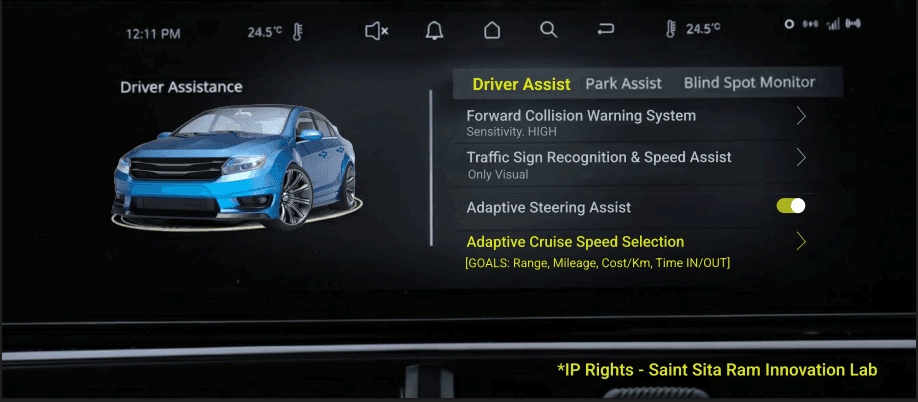
Adaptive Cruise Speed Control Assistant extends conventional and adaptive cruise control systems by intelligently adjusting cruise speed based on defined operational goals rather than relying solely on vehicle-following distance or past driving history.
Traditional cruise control maintains a fixed speed selected by the driver, while adaptive cruise control (ACC) automatically adjusts vehicle speed to match the speed of a preceding vehicle using sensors and radar. Existing ACC systems primarily focus on maintaining safe distance and, in limited cases, improving fuel mileage using isolated parameters such as road slope. These systems do not comprehensively account for multiple real-world factors that significantly influence vehicle range, mileage, running cost, and fuel or energy consumption.
The Adaptive Cruise Speed Control Assistant addresses these limitations by correlating speed, range, mileage, fuel cost per kilometer, and fuel or charge consumption to support informed and goal-oriented driving. Instead of predicting range solely from past driving behavior, the system evaluates vehicle-specific characteristics and operational conditions such as passenger load, goods load, tyre pressure, air-conditioning usage, and vehicle usage life to determine an optimal cruise speed under standard operating conditions.
The system enables automatic or manual modification of adaptive cruise speed based on user-defined goals, including: Maximizing range to reach a destination, fuel station, or charging station without running out of fuel or charge; Improving mileage to reduce running cost per kilometer; Reducing fuel or energy consumption per kilometer to lower emissions; Achieving fuel or charging at lower cost across different geographical regions; Complying with travel distance and time restrictions in regulated zones.
By dynamically adjusting cruise speed, the system assists users in meeting "just-in" and "just-out" time requirements for restricted areas, fuel stations, charging stations, or zones with variable pricing based on time of day. It also supports route-level decision-making by factoring in alternate routes, geographical fuel price variations, and refueling or charging costs specific to vehicle make and model.
Common Meeting Point and Vehicle Coordination: The Adaptive Cruise Speed Control Assistant further supports coordination between two or more vehicles required to meet at a common location for a shared operation. When multiple vehicles are traveling at different speeds and are expected to arrive at different times—resulting in waiting time, parking effort, or idle operation—the system assists by recommending appropriate cruise speed adjustments. By analyzing relative speeds, distances, and estimated arrival times, the system can suggest speed modifications for one or more vehicles so that all vehicles reach the common meeting point at approximately the same time. This coordinated arrival helps reduce waiting time, unnecessary parking, congestion, and energy consumption, thereby improving overall operational efficiency.
Multi-Modal Applicability: Beyond road vehicles, the Adaptive Cruise Speed Control Assistant is designed to be applicable to electric vehicles, CNG vehicles, trains, buses, ships, and aircraft, where controlled speed adjustment is required to optimize energy usage, reduce congestion, improve safety, and meet time-based operational constraints.
Overall, the system provides assistance, guidance, and optional automation to help users operate vehicles at optimal cruise speeds, balancing range, cost, efficiency, compliance, coordination, and environmental impact in real-world driving and transport scenarios.
Key Features
Interested in this IP?
Contact our licensing team to discuss commercialization opportunities and patent rights.
Email Us
info@ssrinnovationlab.com
Call Us
+91 7814532488
+91 9530966789